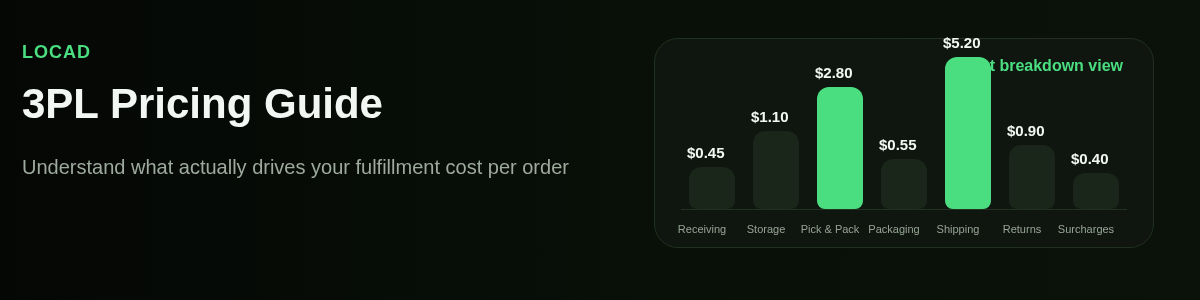
3PL Pricing Guide for E-commerce Brands
If you are comparing 3PL providers in the US, this guide helps you understand what you will actually pay and how to avoid pricing surprises after onboarding.
Reviewed by Locad GTM and fulfillment solutions team. Last updated: 2026-04-17.
Quick answer: What drives 3PL pricing the most?
For most US e-commerce brands, the strongest cost drivers are order profile (items per order), shipping zone mix, storage velocity, and return handling. The fastest way to reduce cost per order is to improve pick efficiency and shipment-zone economics together instead of negotiating only one fee line.
Use this guide with the 3PL Cost Calculator and the 3PL Pricing Template to move from rough estimates to decision-ready numbers.
What does 3PL pricing usually include?
Most 3PL quotes combine variable charges and fixed monthly charges:
- Setup and implementation fees
- Inbound receiving and putaway
- Storage (bin, shelf, pallet, or cubic-foot based)
- Pick and pack charges
- Packaging materials
- Shipping charges and carrier surcharges
- Return handling and restocking
- Account management or software platform fees
A quote that looks cheap on pick fees can still be expensive after add-ons. Always normalize the full stack.
3PL pricing models you should benchmark
Per-order model
You pay a fixed amount per order plus storage and shipping. This is common for predictable SKU profiles and stable average items per order.
Activity-based model
Each action has a fee, receiving, pick line, additional item, kitting, labeling, and returns. This is transparent but can be volatile if your workflows change.
Tiered volume model
Rates drop after volume thresholds. Useful for brands scaling fast, but only if tiers and definitions are explicit in contract language.
Hybrid model
A base monthly fee plus reduced transaction charges. This can reduce variance if your order volume is seasonal.
Comparison table: how to evaluate quotes fast
| Pricing area | What to ask each 3PL | Risk if unclear |
|---|---|---|
| Setup fee | Is this one-time, phased, or waived at volume? | Hidden onboarding spend |
| Receiving | Charged per carton, pallet, or hour? | Inbound bill shock |
| Storage | Billing unit and minimums per location? | Paying for unused space |
| Pick and pack | First item vs additional item logic? | Margin erosion on multi-item carts |
| Shipping | Blended rates or zone-level pass-through? | Inaccurate landed cost planning |
| Returns | Restock, inspection, disposal fee schedule? | Underestimated reverse logistics cost |
| Surcharges | Fuel, peak, residential, oversized rules? | Unexpected seasonal penalties |
Practical benchmark framework for cost per order
Use this monthly formula:
(Pick + Pack + Shipping + Receiving + Storage + Returns + Surcharges + Platform Fees) / Total Fulfilled Orders
Then track by channel and by destination mix. A single blended number is useful for finance, but operational teams need channel-level visibility to improve margins.
What a complete 3PL pricing workflow should include
The strongest pricing resources usually combine three things: a planning asset you can work from, a calculator you can test with your own assumptions, and clear explanations of hidden fees before you sign with a provider.
Planning scenarios for e-commerce brands
Scenario A: 1,500 orders per month
Best for early-stage DTC operations. Keep model simplicity high, monitor pick-and-pack efficiency weekly, and avoid contracts with rigid minimums that outpace your current order profile.
Scenario B: 5,000 orders per month
At this level, small changes in shipping blend and additional-item fees materially affect margins. Use your template monthly and maintain a separate return-cost assumption instead of hiding it in a generic buffer.
Scenario C: 20,000+ orders per month
Volume supports stronger pricing negotiations, but complexity rises. Build lane-level shipping assumptions and ask for explicit tier thresholds to avoid pricing resets during growth periods.
Hidden-fee checklist before final selection
- Receiving minimums and weekend receiving rates
- Special project labor (rework, relabeling, kitting changes)
- Return exception handling charges
- Packaging material markups and dunnage rules
- Residential, fuel, oversized, and peak surcharges
- Storage overage penalties during demand spikes
What to negotiate before signing
Lock your surcharge definitions
Get written definitions for peak, fuel, oversized, and remote-area charges.
Define service-level credits
If SLA misses happen, include a commercial remedy path instead of vague support language.
Clarify rate-review windows
Annual adjustment rules should be explicit, including notice periods and exception logic.
Ask for growth-path pricing
If your volume doubles, your pricing should improve on pre-agreed tiers instead of requiring a full contract reset.
Frequently asked questions
What is a good 3PL fulfillment cost per order?
There is no universal number. A good fulfillment cost per order is one that fits your margin profile after product cost, shipping, returns, customer acquisition, and operating overhead are accounted for. Brands with healthier gross margins can absorb a higher fulfillment cost if service levels and growth outcomes justify it, while lower-margin brands need much tighter cost control. The better benchmark is not a generic market average, but whether your fulfillment cost supports sustainable contribution margin by channel over time.
Should I use one national 3PL or multiple regional 3PLs?
Start with service-level consistency, landed-cost control, and how much operational complexity your team can absorb. In many cases, the strongest option is one fulfillment partner with a deep regional warehouse footprint, strong carrier coverage, and smart order-routing logic that can place inventory well and choose the best shipping path by destination. That gives you the simplicity of one operating layer without giving up regional speed.
Is a 3PL pricing template enough for vendor selection?
A template is necessary but not sufficient. Use it with sample invoices, SLA terms, and scenario testing before making a final choice.
How often should I refresh my 3PL pricing model?
Review monthly, and also after major carrier updates, promotion cycles, and new-channel launches.
What hidden 3PL fees should I ask about before signing?
Ask for a written breakdown of receiving minimums, storage minimums, packaging material markups, return handling fees, special-project labor, account-management charges, and peak-season or fuel surcharges. A quote can look competitive on pick-and-pack rates and still become expensive once these line items appear on invoices.
How should I compare two 3PL quotes that use different pricing models?
Normalize both quotes into the same monthly scenario using your real order profile, item-per-order average, storage needs, return rate, and shipping-zone mix. The cleanest comparison is total fulfillment cost per order and total monthly cost under the same assumptions, not whichever provider presents the simpler-looking rate card.
Should I track 3PL cost per order by channel or as one blended number?
Track both, but use channel-level reporting to make decisions. A blended number helps finance see the overall trend, while channel-level cost per order shows where margins are being pressured by marketplace fees, return rates, order composition, or destination mix.
Next steps
- Run your baseline in the 3PL Cost Calculator
- Download the 3PL Pricing Template
- If you want a custom model, talk to Locad
Ready to get started?
Talk to our fulfillment experts and see how Locad can help your business grow.